 RYBA LAB
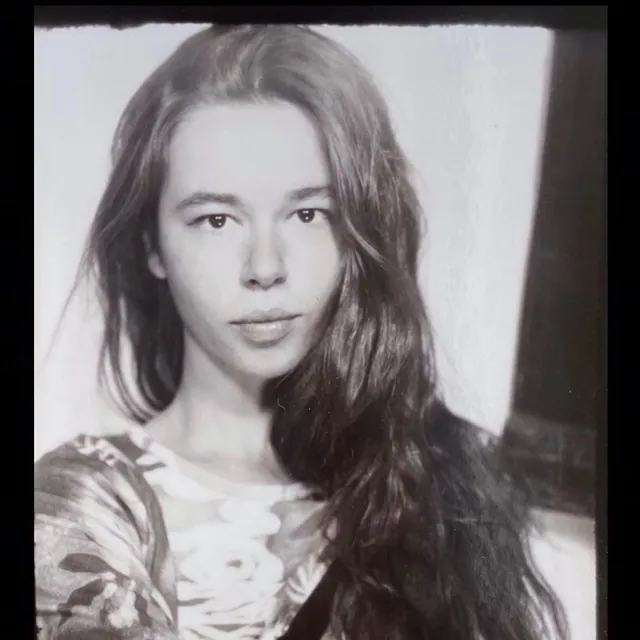
Nastia Sopilnyk
Moving image, photography, performance
Artist and documentary maker from Odesa, studies media art at the Leipzig Academy of Fine Arts. Combines documentary and artistic methods, exploring people and public space through performative interventions.
- Education
- Leipzig Academy of Fine Arts, media art
- With RYBA LAB
- From Tides to Ebbs · 2025
From Tides to Ebbs · 2025
Untitled
2025 · Redscale photographs
Shot on redscale film; the series turns the sea red.View in the exhibition
At the exhibition
Museum of Contemporary Art Odesa · 2025
red orange yellow green blue black
One of my favourite things to do as a child was to dive under the water, open my eyes, try to navigate the seabed and see to urgent underwater childhood business. A blurred image, a rough sense of the axes left–right–up–down, and blue lips. Looking into the sea became looking through the sea, and if remembering in images turns out to be true, my memories of the sea are rather blurred. To navigate uncertainty, to read in fragments, through distortion and convention. The sea deliberately misleads, disorients, darkens and lays bare its opacity, takes back what is its own.
Descending to what was then a record depth, the marine biologist William Beebe was one of the first to describe the ocean as an optical medium that limits or shapes visual perception like a filter. Going down in a futuristic construction, a kind of bio-techno-sphere, he watched the colours disappear one after another, the rainbow gradually separating into layers and fading into complete darkness. An uncontrolled disappearance, witnessed by a spectrometer.
In repeated attempts to capture what flows, I dive with a camera and wonder whether documentary is possible where opacity is a given. The least (un)obvious things become poetic by default. I think of Valentyn Khrushch’s painting “Odesa Humidity”, and of how my friend V. once mixed up my phone with his on an Odesa evening — without either of us planning it, both had this painting as the lock screen. It is painted in broad, abstract watercolour strokes and seems a direct imprint of the body of Odesa air, more a testimony than an artistic gesture. As an almost imperceptible intervention in the left corner: a fragment of Agfa film packaging. One more attempt to make out and hold on to this endless drifting in the sea fog, and to find a place for oneself in it.
To accept opacity, to lose red, orange, yellow, green and blue in order to find black.