 RYBA LAB
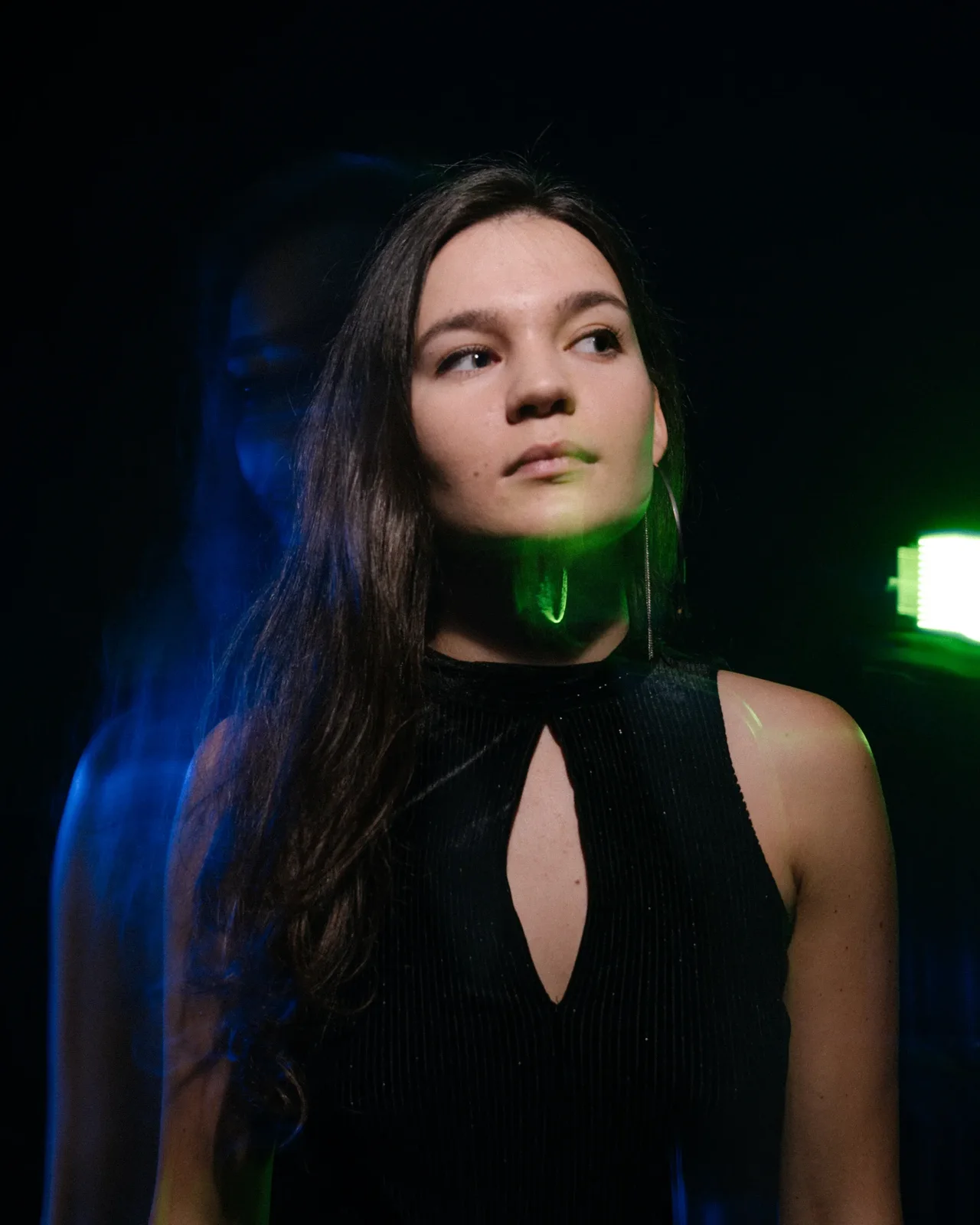
Sofia Holubeva
Painting, graphics, ceramics, installation, performance
Sofia Holubeva explores memory, loss and vulnerability — personal and collective — tracing how war and other forces affect space, the body and everyday life. Her works often turn to home, family and connection, involving relatives in her projects. She also examines how the digital age changes the language of art, especially painting.
- Education
- MA in Fine Art, Kyiv Academy of Arts (2021); Contemporary Art course, Kyiv Academy of Media Arts (2021); Fine Art and Art in Context, Berlin University of the Arts (2022–2025)
- Residencies
- Exter, Berlin Art Institute; Desire Lines, Begehungen Festival; Malt AIR, Maltfabrikken
- Grants
- EU Delegation to Ukraine; Ernst von Siemens Foundation; Danish Arts Foundation
Abyss. Life in the Dark · 2026
The Eye
Three works, oil on canvas
What does it mean to “see” in a world where we can see more and more, yet ever more rarely see directly?
The series The Eye explores how technology changes the human way of seeing the world. Each of the three works corresponds to a mode of observing the sea: from a satellite, from the air and from under water. The satellite watches the Earth’s surface from space, the drone records space from above, and the underwater vehicle carries observation into an environment where human vision is severely limited.
These technologies produce different images and work with fundamentally different physical phenomena. A satellite sensor registers the spectral characteristics of radiation, a drone camera captures reflected light and spatial information, and sonar works with acoustic reflections. A physical signal is turned into data, data into an image, and the image becomes accessible to the human gaze once again. It is this process of translation that lies at the heart of the work. The image is no longer a direct trace of what the human eye has seen.
The Black Sea is a space that can never be seen in its entirety. For Odesa it is part of everyday life and memory, a natural environment and at the same time a territory that, in wartime, becomes an object of surveillance, research and control. Technology reveals what remains invisible to people, but every instrument creates its own version of the visible.
Satellite, aerial and sonar data become the basis for painting — yet another mode of translation. Painting returns machine vision to matter and to human perception. It does not reproduce an “original reality” but creates a new level of distance, where the machine image meets the human gaze once more.
Lab interview
Answers from the online lab of Abyss. Life in the Dark, 2026.
Tell us briefly about yourself, what you do and the theme you are working with at the lab
At the lab I am working on the project The Eye, which explores how the human perspective is changing through contemporary observation technologies — drones, underwater cameras and digital images. I am interested in how new instruments of vision change our perception of ourselves, of the landscape and of the very notion of presence.
What was the beginning? Which image, phenomenon or scientific fact became the starting point of your work?
During the war we constantly encounter images obtained through observation technologies: drone footage, satellite imagery, underwater surveys. The camera becomes a mediator between us and reality — it lets us see what is inaccessible to the human body, yet at the same time it changes the very way we perceive.
Today the same instrument is used for scientific research, for environmental monitoring, for documentation and for waging war. It is this dual nature of the drone as an “eye” that can both know and control that is an important theme of my artistic research.
Which scientific theme or research did you work with, and what struck you most about it?
I worked with ocean observation, underwater technology and the study of the marine environment. What struck me most was that most of the ocean still remains invisible to humans and accessible only through robotic systems. To explore it, people need technological “extensions” of their own bodies — cameras, robotic vehicles, sensors.
Which traits of deep-sea life turned out to resonate most with human experience for you?
I was drawn to the ability of deep-sea organisms to exist amid pressure, darkness and constant adaptation.
The ability to live under constant pressure and adapt to change became a way for me to think about human vulnerability and endurance in wartime.
Has your attitude to the sea changed after working on this project?
Yes. Before, the sea was above all a space of memory, personal experience and belonging for me — as for someone who grew up in Odesa.
After working on the project, I came to perceive the sea as a more complex system with its own memory, invisible processes and forms of life. I began to look at it as an environment that calls for a different kind of attention.
What question would you like to leave the viewer with after encountering your work?
Who is looking at the world today — the human or the technology?
And how does our responsibility for space change when we can “see” more than ever before, yet move ever further away from direct experience?
From Tides to Ebbs · 2025
The Sea Looks at You When You Look at the Sea; Zhytti; Letter to the Sea
Painting with sound (with Kseniia Kostina); installation of algae and stones; text
Artist’s text
Letter to the Sea
The third letter from the series Conversations with the Sea — a text and a video recorded on Arcadia beach.
Read the letter → View in the exhibition →Two voices on water bloomProcess
Sketches, the studio, collecting algae and installing Zhytti, 2025